
A call for a Canada based on caring for the Earth and one another, The Leap Manifesto was released today.
Read How Can We Afford the Leap? by CCPA National Executive Director Bruce Campbell, CCPA BC Senior Economist Marc Lee and CCPA BC Director Seth Klein.

Featuring CCPA MB Director Molly McCracken and Neil McArthur, Department of Philosophy, University of Manitoba. Hosted by the University of Manitoba Centre for Professional and Applied Ethics.
Tuesday September 22nd. Doors 6 pm; Panel 7 – 8 pm
Fools and Horses Coffee Co. 379 Broadway
Free event, everyone welcome

By Robert Chernomas and Ian Hudson teach economics at the University of Manitoba and are Research Associates of CCPA MB.
The Harper government has a two-fold strategy to undermine Medicare. One part of the game plan is to underfund Medicare creating “shortages” over the medium run without making a politically unwise frontal attack against the not-for-profit publicly funded and organized health care system cherished by Canadian citizens. When it expired in 2014, the Conservative government refused to renegotiate the 2004 Health Accord. According to research by the Council of the Federation, a body comprising Canada’s 13 premiers, the provinces and territories will receive $36-billion less over the next 10 years. In effect, the federal government is balancing its budget on the backs of the provinces. In response, provinces are left with difficult choices: de-list needed services and invite more private health care providers as wait times increase or raise taxes and redistribute tax dollars from education and other public services.

Book launch Wednesday October 21, 7 pm at McNally Robinson Booksellers Grant Park Mall
Community Symposium Thursday October 22, West End Commons, 641 St. Matthews Ave.
RSVP at Event Brite
8:30 am – 4 pm

Edited by Lynne Fernandez, Shauna MacKinnon and Jim Silver
Book Launch
September 24
McNally Robinson Booksellers
Grant Park Shopping Centre
7 pm
Books will be available after September 24 for $25.00 each from the CCPA office 205 – 765 Main St. Call 204-927-3200 for your order today or pick them up at the book launch on September 24th.

By Mihiri Witharana and Joyce Slater
People are food insecure when they do not have access to, or enough money to buy safe and nutritious food, preventing them from enjoying a healthy diet. Food insecurity is major concern for many low-income Winnipeg families. Aboriginal and Newcomer refugee families are among the poorest in Winnipeg, and have very high rates of food insecurity, which is closely related to poor nutritional health. Too many children have diets that are too high in sugar, fat and salt from eating an abundance of highly processed and fast foods, which can be less expensive than healthier alternatives. This contributes to one third of Manitoba children being overweight or obese.
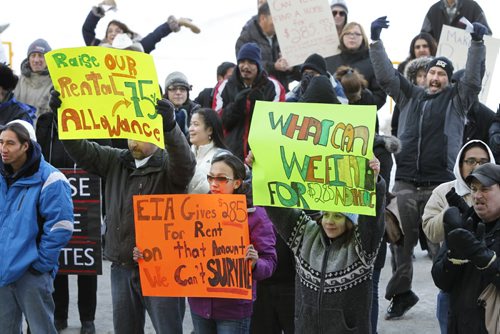

Thanks to community advocacy, low-income Manitobans will have more money to help pay their rent. Three years ago Make Poverty History Manitoba (MPHM) began building support for increasing shelter benefits to 75 per cent of median market rent. The provincial government responded and this July, low-income people will have better access to a safe and affordable place to live.
Refugees across Canada are facing a structural housing crisis. Stagnant shelter allowances for the Government Assisted Refugees eligible to receive them, a federal retreat from social housing provision, and skyrocketing housing costs in numerous Canadian cities since the early 1990s, have all contributed to this. The Manitoba Interfaith Immigration Council (MIIC), the organization with whom we have partnered for our ongoing Manitoba Research Alliance funded-research into refugee housing outcomes, has been actively calling for innovative housing solutions for their clientele. This year, their sentiments were echoed by refugee-serving community-based organizations at the Canadian Council for Refugees (CCR) Spring Consultation 2015, held in Winnipeg May 21-23. As a result, refugee housing experiences are now part of an important national discussion about what it takes to build a home for refugees in supportive communities.
By Molly McCracken, Director of CCPA-MB
Social service schemes announced this week by the Manitoba Progressive Conservatives to encourage private childcare and introduce Social Impact Bonds soften the ground towards privatization. The assumption is that the private sector knows best how to fund and deliver public services. This is false – publicly delivered services are more efficient, accountable and in the long-term public interest.

By Toby Sanger, Senior Economist CUPE National
At a time when the Ontario Liberal government is planning to privatize Hydro One and other provincial governments are also planning significant privatizations, it’s instructive to look back and see what the impact of earlier privatizations has been.


Follow us!