
By Lynne Fernandez,
Winnipeg cannot control broader macro pressures such as climate change or a stagnant global economy, but it can prepare for the changes that are coming. It can meet climate change with policy to mitigate damage, slow the rate of change, and build resilience. It can stimulate and grow the local economy while making sure that marginalized citizens are included. It can put the brakes on wrong-headed practices like urban sprawl or over-spending on policing, while redirecting resources to deal with the root causes of crime and our infrastructure deficit, and smooth out the inequalities that keep our city from realizing its full potential.
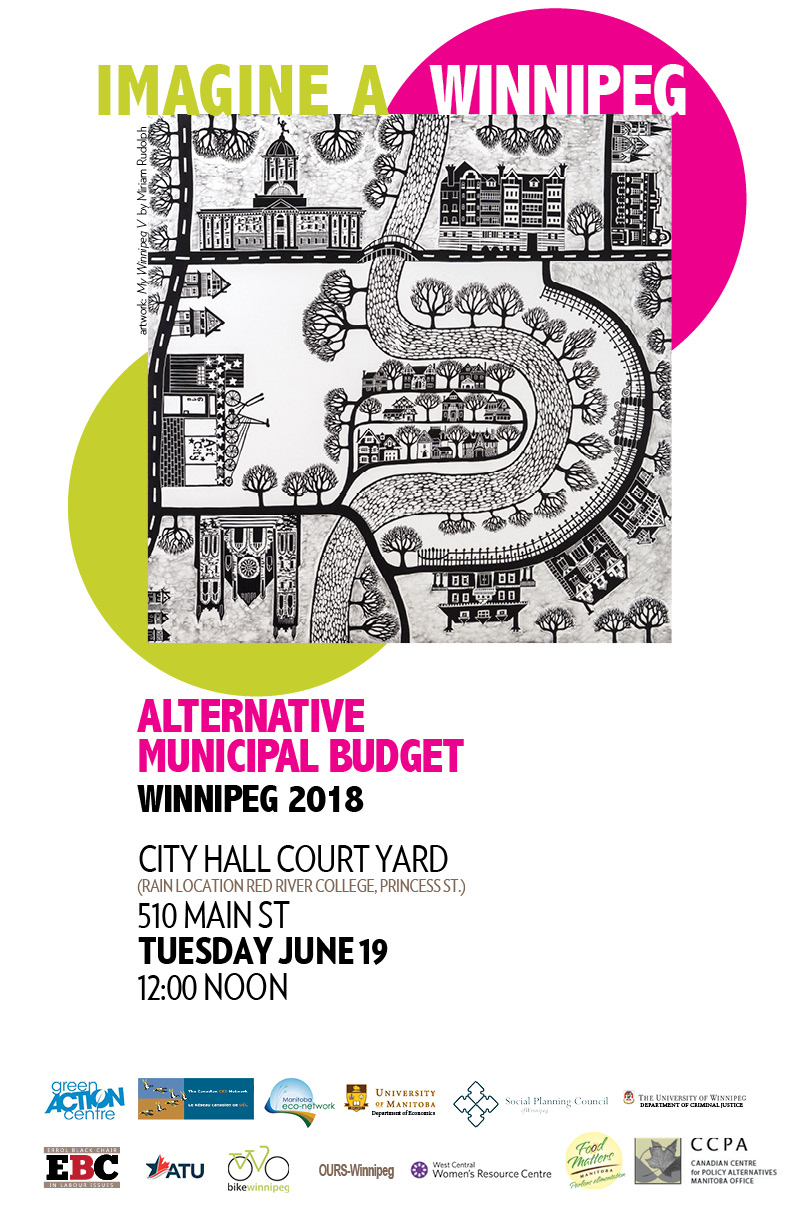
The 2018 Alternative Municipal Budget (AMB) is a community response that dares to imagine a greener and more equitable Winnipeg.
By Ian Hudson and Benita Cohen,
A decade ago the CCPA-MB released the Stuck in Neutral report on inequality in Manitoba. Although inequality was less pronounced in Manitoba than it was in other provinces, earnings for the poorest 40% of families were either no higher or actually lower in the early 2000s than they were in the late 1970s, despite families working longer hours. Since that report was released the global economy suffered through a massive economic crisis in 2008, oil prices spiked and collapsed, and provincial governments have come and gone. It seemed a reasonable time to update the study to see if the trends uncovered in the early years of the new millennium still hold.
By Elizabeth Comack,
The Free Press (May 23 and 26, 2018) recently reported on the case of an Indigenous man who served more than six months in jail after pleading guilty to a break and enter. It later came to light that the man was innocent of the crime because he was incarcerated at the time the incident occurred.
This story should give us pause to consider some of the factors leading people into the criminal justice system — and what happens to them when they get there.
By Harvey Stevens,
When British Columbia introduced its carbon tax, it provided a rebate to families to offset the higher cost of goods and services created by that tax. It designed it as a refundable tax credit that diminished in value as family income increased. As of 2017, the program provided a maximum yearly rebate of $120.40 per adult and $35.88 per child with the clawback starting at $38,880 for families and $33,326 for individuals at a rate of 2 per cent of family income.
By Lynne Fernandez
In February, a provincial news release about changes to agricultural crown lands advised that “The Manitoba government has launched a consultation focused on agricultural Crown lands, to ensure upcoming policy changes reflect the views of the livestock industry while improving fairness and transparency in the system […]”.
How will these changes affect the Community Pastures Program, part of what was the federal government’s Prairie Farm Rehabilitation Administration initiative? Referred to as “Canada’s greatest success story” – the program started in 1935 to deal with the devastation the Dust Bowl brought to the southern prairies. It included initiatives to deal with erosion, water access, irrigation and grass management through the Community Pastures Programs. These pastures are found in Alberta, Saskatchewan and Manitoba and cover over 2 million acres in total.
FOR IMMEDIATE RELEASE [May 2, 2018]: Make Poverty History Manitoba launched it’s city poverty reduction plan Winnipeg Without Poverty: Calling on the City to Lead at 10am, May 2.
This report, endorsed by more than 90 organizations, calls on Winnipeg’s Mayor to be a champion for poverty reduction and commit to leading the development of a comprehensive poverty reduction plan. Up to 107,000 Winnipeggers are living in poverty.


Follow us!