

By Lynne Fernandez
In a new Canadian Centre for Policy Alternatives MB report on Manitoba’s public-sector pensions Pensions in Manitoba: What’s Working, What’s Not, author Hugh Mackenzie dispels many myths about public and private sector pensions. He anchors his analysis in the context of Canada’s retirement income policy and its three main players: Old Age Security (OAS) and the Guaranteed Income Supplement (GIS); the Canadian Pension Plan (CPP); and, workplace based pension plans.
By Marina Puzyreva and John Loxley,
As the Inquiry into Missing and Murdered Indigenous Women and Girls (MMIWG) continues, a new study looks at the problems of reactive government policy on MMIWG in Manitoba.
The complex impacts on family members of MMIWG are examined in Cost of Doing Nothing: Missing and Murdered Indigenous Women and Girls. This study is a preliminary estimate of the cost of doing nothing to prevent many Indigenous women and girls from going missing and being murdered. It gives an insight into the emotional journeys of the families left behind. It also assesses the current financial cost of dealing with this tragedy based on calculations drawn from the literature and estimates of the number of MMIWG in Manitoba.
By Ellen Smirl
Government-issued identification (ID) is essential to gain access to a wide range of government entitlements, commercial services and financial systems. Lack of ID on the other hand, represents a critical barrier that prevents low-income Manitobans from accessing these services and benefits, and ultimately results in further marginalization and deepening poverty. A new study, Access to Identification for Low-Income Manitobans researches what can be done to address these challenges.
By Mark Hudson
First published in the Winnipeg Free Press Oct. 5, 2017
A draft “Climate and Green Plan Town Hall Toolkit” circulated within the Manitoba government proposes a flat $25 carbon tax. While this is only a discussion document, and not yet policy, it’s a worrying sign of what the much-trumpeted “Made-in-Manitoba” climate policy might look like: a piece of largely-pointless window-dressing.
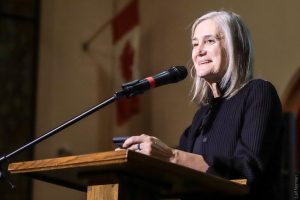
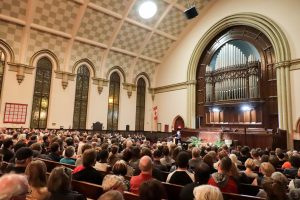
Amy Goodman, Democracy Now! Stories of Democracy Resistance and Hope presentation at Knox United Church, Friday Sept 29th.
See story in the Manitoban here.
Photos by Leif Norman
Jon Young and Brian O’Leary
Introduction1
High quality public schooling is an expensive commitment. In Manitoba the operating costs for the 2015-16 school year was $2.24 billion, which translates to an average per pupil operating cost of $12,537 (Manitoba Education and Training, 2017). In May of this year the Minister of Education and Training, Ian Wishart, announced plans to initiate a full-scale, long-term, review of education funding in the province. This short Fastfacts seeks to contribute to the review by suggesting three overarching themes to guide it: the importance of education as a public good; the importance of avoiding any drift towards a two-tiered public school system in the province; and, the importance of spending available resources wisely. 2
By Molly McCracken
Last week I was chatting with my uncle, a retiree on a fixed income, about the health service cuts at the Winnipeg Regional Health Authority. He said “if the deficit is $83 million, why doesn’t everyone just paid a bit more in taxes and then cuts would not be required?” With consideration for one’s ability to pay, why not indeed?
By Carlos Sosa
In April of 2017, it was announced that there would be dramatic changes in the way that healthcare would be delivered in Manitoba. One of the biggest users of the healthcare system are marginalized populations who live in poverty especially persons with disabilities and seniors. The changes that were announced include the closures of Seven Oaks, Concordia, Victoria Hospital emergency rooms and Misericordia urgent care centre in Winnipeg. With plans for the Seven Oaks and Victoria Hospital emergency rooms to be converted into urgent care centres. As a person with a disability and Elmwood resident, I immediately had concerns regarding how this short-sighted decision will have a detrimental impact on marginalized communities in North East Winnipeg. In my area people living in poverty which includes persons with disabilities face many barriers when it comes to accessing healthcare. The changes announced further complicate the barriers to the medical system that people living in poverty and with disabilities encounter on a daily basis.

Presentation by Dr. John Loxley
Thursday August 31
Doors open at 11:30
Presentation, Q & A 12:00 – 1:15
Millennium Library
RSVP to ccpamb@policyalternatives.ca or call 204-927-3200
First published in the Winnipeg Free Press Friday July 14, 2017
By Lynne Fernandez and Ian Hudson
In March of 2017, the Premier claimed that for every one per cent the province lowered (or didn’t raise) wages for 120,000 provincial public sector workers, it would save $100 million. This simple calculation provides grist for Bill 28, The Public Services Sustainability Act which mandates all those who employ provincial public sector workers to hold future increases to zero per cent for the first two years of a new contract, no more than 0.75 per cent for the third year, and no more than 1.0 per cent for the fourth.


Follow us!