
By Lynne Fernandez
Notwithstanding stable economic growth and consistently low unemployment, poverty remains a problem in Manitoba. In 2014, 11 per cent of Manitobans lived in low income. That’s down from 11.8 per cent in 2011, however child poverty continues to be stubbornly high, with the 2014 rate at 16.2 per cent.
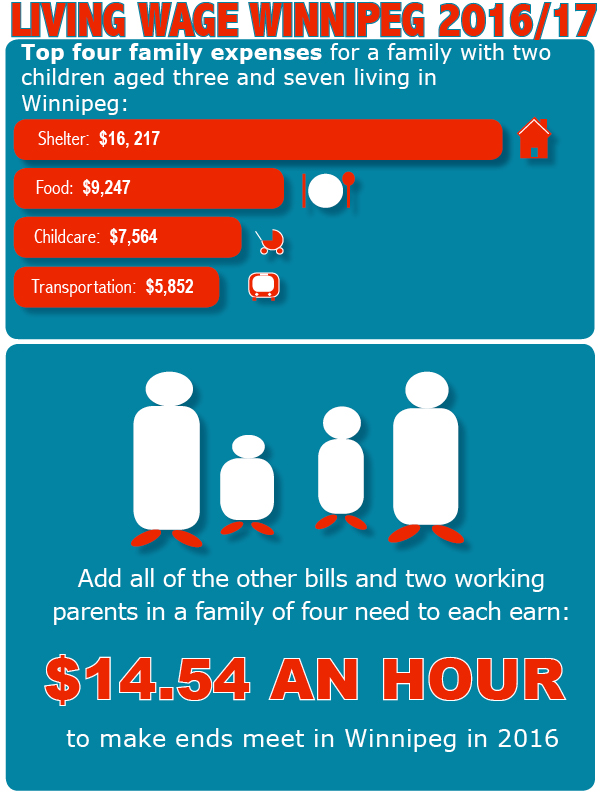
Winnipeg: The most recent living wage for Winnipeg, Brandon and Thompson will be released on Thursday June 29th at 12:00 at the Social Enterprise Centre, second floor 765 Main St. by economist Lynne Fernandez.
The Living Wage is a regional calculation based the amount that a family of four needs to earn to meet basic expenses. The living wage is based on the local cost of rent, groceries, transportation, child care and extended health care. It does not include debt repayment, pension or long term savings.
A living wage addresses child poverty and is an opportunity for employers to do better than pay the legislated minimum wage. The living wage takes into account government transfers and demonstrates how public policy in areas like housing and child care can positively impacts families.
The living wage calculation is a standard calculation used by the offices of the Canadian Centre for Policy Alternatives.
The most recent update in 2013 found the living wage for Winnipeg as $14.07/ hour, Brandon as $13.41/ hour and Thompson as $13.46/ hour. Join us this Thursday at 12:00 noon to learn how much it has increased.
Directions to the Social Enterprise Centre, 765 Main St.
http://www.secwpg.com/contact/
Join us at noon on Thursday June 29th at the Social Enterprise Centre at 765 Main St for the Living Wage Report for Manitoba.
12:00 – 1 pm
By Shauna MacKinnon
On Friday May 26, I attended an impromptu event organized by supporters of the North Point Douglas Women’s Centre. The event was held to show support for the Centre, which was reeling from the news that it would not receive an expected $120,000 required for its operations. This represents one third of the Centre’s budget and losing it means that North Point Douglas Women’s Centre will be forced to cut important programs that are serving the community well. It got me thinking about reconciliation.
Indigenous women spoke passionately about the important role the Centre plays in their lives. They spoke about the culturally based programs that are helping them to heal from intergenerational trauma caused by government policies and programs like residential schools. As I listened to these women, it became clear that the Provincial government’s decision to cut funding for this and other community based programs serving high numbers of Indigenous peoples, is inconsistent with the Truth and Reconciliation Commission 94 Calls to Action and Manitoba’s Path to Reconciliation Act.
Premier Brian Pallister announced will be riding his bicycle from the St Peter’s Reserve (Selkirk) to Peguis First Nation this June 16 – 17 to recognize the 200th anniversary of the Selkirk Treaty. This blog summarizes the responses by Peguis First Nation member Tim Stevenson and CCPA Manitoba director Molly McCracken to the June bike tour.
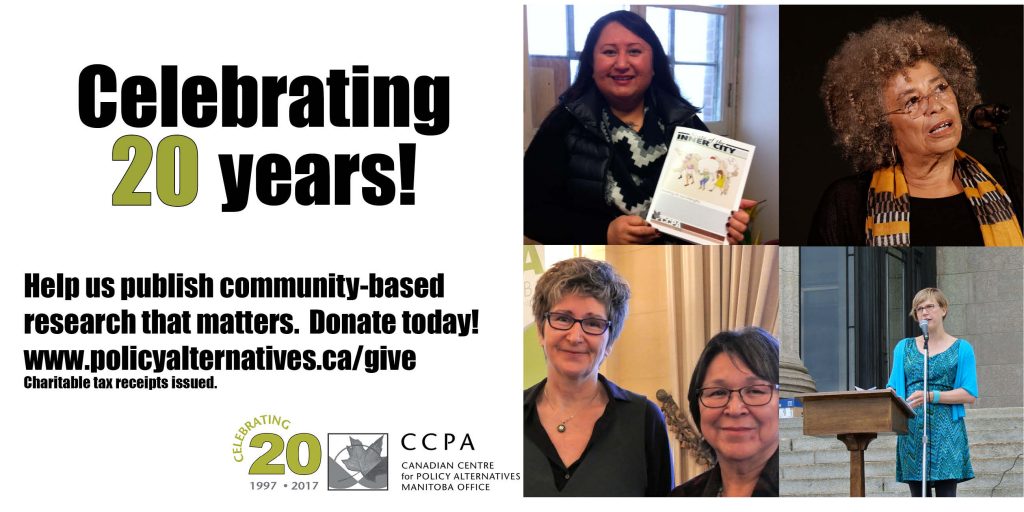
This year the Manitoba office of the Canadian Centre for Policy Alternatives celebrates 20 years of independent research, analysis and expertise. From last year’s talk by Naomi Klein to this year’s address by black freedom movement icon Angela Davis, the Canadian Centre for Policy Alternatives (CCPA) Manitoba is at the forefront of progressive thought in our province.
20 years of CCPA Manitoba research and commentary is due to the dedicated support of individuals, organizations and unions. If you are a supporter, thank you. If you are not – please consider donating today to keep progressive ideas on the public policy agenda. WE NEED YOU! Big right wing think tanks are active in Manitoba – we struggle for space in the media against them all the time. Thanks to your support we can make sure we’re at every key policy discussion and decision, such as presenting on the regressive Bill 33, which entrenches minimum wage as a poverty wage; read our presentations and commentary.
The following is a sampling of what we’ve been able to accomplish thanks to the support of Manitobans concerned about evidence-based public policy to advance social, economic and environmental justice.
By Josh Brandon and Molly McCracken
Working should be a route out of poverty, but for some, low wages are a poverty trap. The current minimum wage is inadequate as at $11/ hour, it places workers as far as $8,000 below the poverty line. Minimum wage should be increased through pre-announced steps to $15.53/ hour and then indexed at that point. The current plan by the Manitoba government would tie minimum wage increases to the rate of inflation or less, freezing or lowering the buying power of the most vulnerable workers in Manitoba.
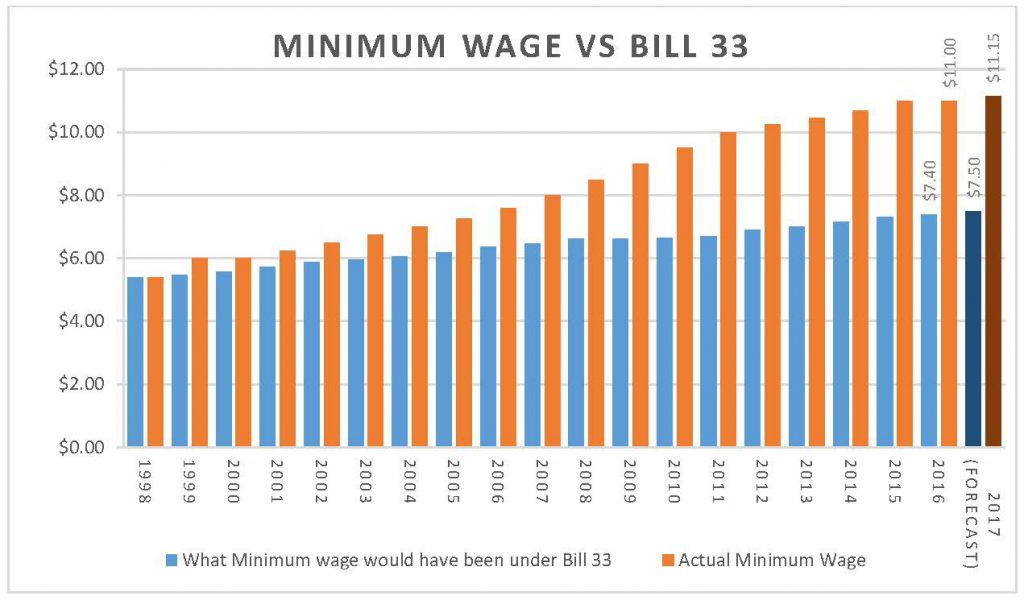
Under Bill 33, future minimum wage increases would be set at the rate of the consumer price index (CPI), or in the case of negative economic conditions such as a recession, no increase will be made. This legislation would give workers only a $0.15 increase in minimum wage in 2017.
Bill 33 Minimum Wage Indexation Act was heard by the Standing Committee on Social and Economic Development on May 23rd, 2017. CCPA Manitoba made two presentations to committee:
Comparing a living wage with minimum wage – Lynne Fernandez Errol Black Chair in Labour Issues
Adequate minimum wage is in public interest – Molly McCracken – Director CCPA-MB


Follow us!