
If the new provincial government had shown a certain amount of restraint up until now, it seemed much more willing to show its hand in Monday’s Throne Speech. A few strong messages emerged: public-sector workers are in for a rough ride; there’s going to be a strong push towards privatization on several levels; and there’s nothing concrete for Manitoba’s northern communities.
It all adds up to a strong austerity agenda.
Before any details were revealed, a false picture of the province’s financial situation was drawn. It was painted with broad strokes to be sure, splattered with words like “fix” and “repair”.
Report by Evelyn Peters and Shelly Craig
While it is widely recognized that Aboriginal people are over-represented in the urban homeless population, most research has focused on Aboriginal homelessness in metropolitan areas. Very little attention has been paid to the issue in small northern towns. The small amount of research that has been done on the topic suggests that there are also challenges associated with Aboriginal homelessness in more remote urban areas, and that there are unique aspects to homeless populations in these areas. This study attempts to contribute to our knowledge about urban Aboriginal homelessness with research on this issues in Flin Flon, Manitoba, a small northern mining community.
Read full report

IRCOM staff and participants.
By Jill Bucklaschuk
As housing advocates across the country recognize National Housing Day on November 22nd, we must continue to acknowledge the central role of housing in building inclusive communities and seek ways to ensure that all low-income families have access to affordable, safe, and good quality housing. Vulnerable and marginalized populations such as newly arrived immigrant and refugee families all too often suffer the indignity of scouring the private rental market for suitable housing only to face discrimination, unaffordable rental rates, poorly cared for buildings, and undesirable neighbourhoods. Upon arrival in Canada, obtaining housing is a top priority for newcomer families, but finding a suitable residence proves to be a profound challenge without social networks, employment prospects, and knowledge about the nature of both rental markets and neighbourhoods.
 By Josh Brandon
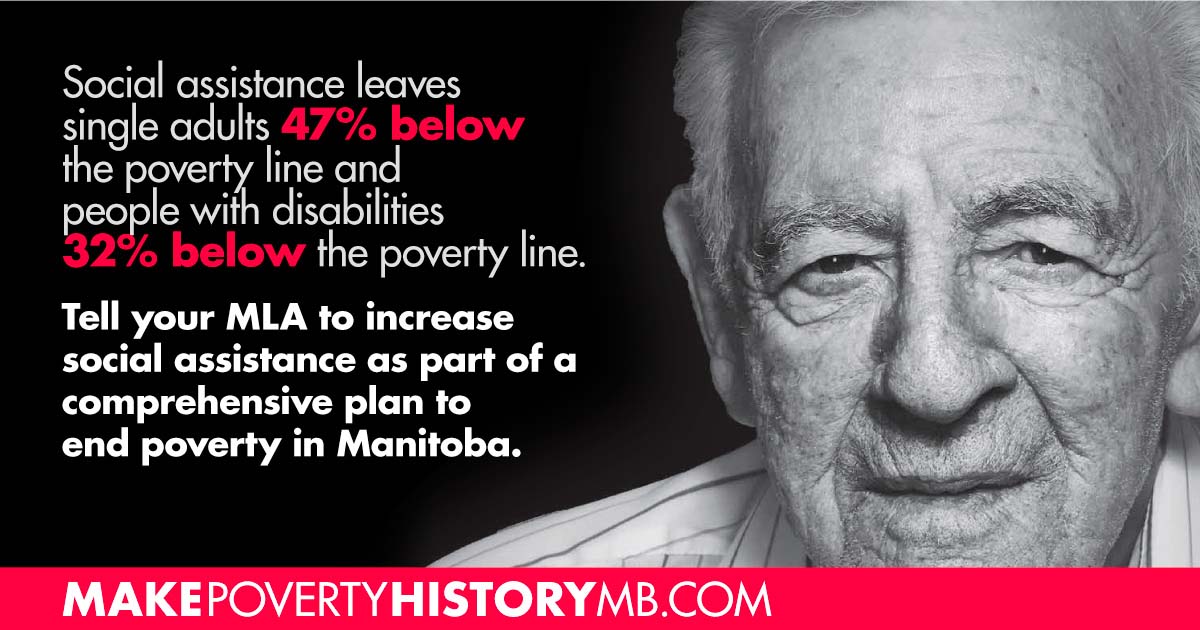
When Lieutenant Governor Janice Filmon delivers the throne speech November 21, a plan for poverty reduction should top the government’s priority list. The Province has promised a plan by next year’s budget and Manitobans are waiting for details.
Poverty comes in many forms, most of them hidden from public view: an empty fridge at the end of the month; a coolness in the room, because hydro rates have gone up and income hasn’t; a mom juggling between her threadbare budget and her child’s unpredictable growth spurts. Poverty reflects the impossible choice of asking not what can be done without, but what is essential that will nonetheless be sacrificed.
Basic Personal Exemption (BPE) increases are being brought in by the new provincial government under the auspices of reducing poverty. The BPE is the floor at which we start paying provincial income taxes.
Not only will these changes do little to help low-income earners, they will bring in less revenue to the provincial purse and undermine the public services that all Manitobans need, especially the poor. Addressing poverty requires more revenue directed at reducing poverty, not less. This is why reducing tax revenue through the BPE in the name of poverty is particularly insidious.
By Lynne Fernandez
In 1995, 19 year old Stephen Nicholson was on the job site working in a paint booth. He was working on the exhaust system and had been lowered into the vent when suddenly paint residue ignited and engulfed Stephen in flames. There was no rescue plan in place and it took several minutes before Stephen was pulled from the vent. He suffered third degree burns to most of his body.
by Lynne Fernandez
On October 28th, an unusual joint statement was released by the University of Manitoba (U of M) administration and the union representing faculty, the University of Manitoba Faculty Association (UMFA). Unusual because these two entities are in the middle of bargaining a collective agreement and one would expect each side to be posturing against the other. No, they haven’t reached an agreement. Remarkably, in clear violation of the right of the parties to engage in collective bargaining, they have had the terms of a one-year agreement dictated to them by a third party.
This is the presentation Lynne Fernandez, Errol Black Chair in Labour Issues made in person for the Provincial Budget Consultation on October 26th, 2016.
Minister Friesen and Panel Members, thank you for inviting me to present this evening.
Recent developments in Churchill and The Pas have focused public attention more on the North. Part of the reason for the growing crisis there is that economic activity has been driven by people and companies that do not have a lasting connection to the places they are doing business, nor have they worked to reduce inequities or respected local cultures.
First published in the Winnipeg Free Press Oct 25, 2016
By Pat and Hugh Armstrong
UBC economist Robert Evans calls user fees in health care zombies, a policy option that keeps surfacing despite being killed over and over again by the evidence. During Manitoba’s recent provincial election Brian Pallister invoked zombies anew by saying that he would not rule out the introduction of private sector options in health care. This would be a mistake.


Follow us!