

by Errol Black
Shortly after being elected with a majority government on May 2, 2011 the Harper government began to show their contempt for the rights of Canadian workers and their organizations.
On June 16, 2011, Harper’s government legislated an end to a two-day strike of CAW members at Air Canada. This was followed on June 20 with back-to-work legislation to end a lockout at Canada Post and force CUPW back to work at a wage imposed by the government with final-offer selection arbitration to follow on other outstanding issues. On October 12, Labour Minister Lisa Raitt preempted strike action by CUPE flight attendants at Air Canada by referring the dispute to the Canada Industrial Relations Board with a directive to impose an agreement or refer the matter to arbitration. On March 8th, Lisa Raitt announced that she had taken similar steps to prevent a lockout by Air Canada of the 3,000 members of the Air Canada Pilots Association, and a strike against Air Canada by 8,600 members of the International Association of Machinists and Aerospace Workers.
In all of these cases, the Harper government claimed that their actions reflected the government’s mandate “to protect the Canadian economy and Canadian jobs.” In effect, this was a declaration that strikes by workers in the federal jurisdiction will not be tolerated by the Harper government.
A bizarre manifestation of the Harper government’s labour doctrine occurred in Brandon, Manitoba with a visit from Public Safety Minister Vic Toews in November 2011. At that time the Brandon University Faculty Association was involved in a protracted, bitter confrontation with an employer intent on crushing the union. While in Brandon, Toews met with the Brandon Sun editorial board to talk about local issues including the strike. On November 22, the Sun published a story by Keith Borkowsky titled, “Toews ‘concerned’ about ongoing professors strike.” According to the story, Toews told the editorial board that “it’s time the provincial government steps in to intervene in the Brandon University faculty strike…Toews said he has encouraged local PCs to speak out on the…strike, but has not yet spoken to Premier Greg Selinger.” In his concluding comments, Toews said he thought that allowing the strike to continue was unacceptable: “I see this strike as counterproductive to what we have been doing [at the federal level with Canada Post and Air Canada…] I have to say, I’m concerned about the inability of the participants to recognize the economic damage this can do to a small centre like Brandon.”
Yet the Harper government showed no concern for the potential economic impact of labour disputes when on January 1st, 2012, 800 United Steelworkers members at Rio Tinto Alcan’s aluminum smelter in Alma, Quebec, and 450 CAW members at a Caterpillar locomotive plant in London, Ontario, were locked out by their employer. Rio Tinto Alcan used 200 of their management employees to maintain output during their lockout and Caterpillar demanded that locked out workers take a 50 per cent cut in wages, and accept degradation of their pension plan and vacation and overtime provisions in the collective agreement. When the workers rejected that demand, Caterpillar declared that it would close the London plant and relocate to Indiana. When the federal government was asked to lean on these firms to get back to bargaining, the Harper government declined to intervene or to use their influence to encourage the Quebec and Ontario governments to step in.
The Harper government has demonstrated their utter disregard for the rights of workers. We can expect the struggle to protect workers rights will intensify in the coming years requiring increased efforts to educate the general population about the destructive effects of government policies that undermine worker and trade union rights and powers, including policies that allow foreign carte blanche takeovers, particularly by U.S. based firms, of Canadian enterprises.
We will continue to follow and document the Harper government’s record on labour issues on PolicyFix. Stay tuned.
[Postscript, March 12, 2012: Labour Minister Lisa Raitt was interviewed by Evan Solomon Saturday morning (March 10) on CBC Radio’s, The House. The interview focused on the latest intervention by Raitt into disputes between Air Canada and two of its unions, the Air Canada Pilots Association and the International Association of Machinists and Aerospace Workers of Canada. At one point in the interview, Solomon asked Raitt if the government’s apparent preoccupation with Air Canada with its dealings with unions was a result of a flaw in the bargaining process at Air Canada. In response, Raitt said “No. In fact, six separate times unions and Air Canada management have reached a deal and shook hands across the table, but then the agreements were rejected by the members. The collective bargaining process works. It seems to be the ratification process that is in dispute.” For Raitt and her government, it seems that “protecting the public and the Canadian economy” (as defined by them) trumps the rights of Air Canada workers and unions. Unfortunately, Solomon didn’t follow up on this particular point.]Errol Black is on the CCPA-MB’s board.
This compilation of stats and figures illustrates the current housing situation, particularly for lower income households, in Manitoba. Winnipeg figures are here.
References are available at the bottom of the page, in case you are looking for more details.
Core Housing Need
Definition of Core Housing Need
“Acceptable housing is defined as adequate and suitable shelter that can be obtained without spending 30 per cent or more of before-tax household income. Adequate shelter is housing that is not in need of major repair. Suitable shelter is housing that is not crowded, meaning that it has sufficient bedrooms for the size and make-up of the occupying household. The subset of households classified as living in unacceptable housing and unable to access acceptable housing is considered to be in core housing need.”(1)
Core Housing Need
In 2006:(2)
- 11.3 % of all MB households lived in core housing need (46,900 households)
- 24.0 % of MB renter households lived in core housing need (28,800 households)
- 6.2 % of MB owner households lived in core housing need (18,100 households)
- 22.3 % of those who immigrated to Canada between 2001 and 2006 lived in core housing need in Manitoba (1,600 households)
In 2006: (3)
- 8.4 % of all Brandon households lived in core housing need (1,640 households)
- 17.4 % of Brandon renter households lived in core housing need (1,220 households)
- 3.3 % of Brandon owner households lived in core housing need (420 households)
- 9.6 % of all Thompson households lived in core housing need (460 households)
- 21.5 % of Thompson renter households lived in core housing need (420 households)
- 1.4 % of Thompson owner households lived in core housing need (40 households)
- 8.3 % of all Portage la Prairie households lived in core housing need (580 households)
- 20.7 % of Portage la Prairie renter households lived in core housing need (400 households)
- 4.2 % of Portage la Prairie owner households lived in core housing need (175 households)
- Data is not available from the 2006 Census for Selkirk.
Renting in Manitoba
Current Vacancy Rates
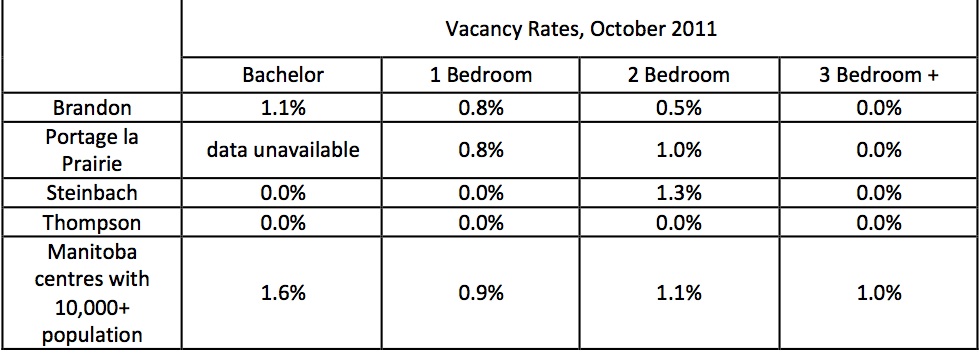
In October, 2011, the vacancy rate was (4)
- 1.0 % in Manitoba, the lowest vacancy rate in the provinces
- 1.1 % in Winnipeg, the second-lowest among all CMAs in Canada
- 0.0 % in Thompson
- 0.6 % in Brandon
- 1.0 % in Portage la Prairie
Vacancy Rates, October 2011 (5)
Rents
In October 2011, the average rent was (6)

In 2011, the Median Market Rent in Manitoba was (7)

Affordability of Average Rents in Brandon (8) (9)

Affordability of Average Rents in Thompson (10) (11)

Affordability of Average Rents in Portage la Prairie (12) (13)

Affordability of Average Rents Compared with EIA Rental Allowances (6) (14)

Demographics
Migration
The population of Manitoba increased by 15,800 people from 2009-2010 (from 1,219,600 to 1,235,400).(15)
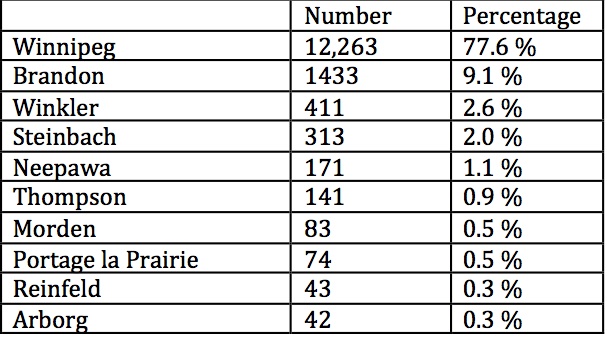
2010 immigration to centres in Manitoba (16)
Social Housing
Manitoba Housing “owns the Province’s housing portfolio and provides subsidies to approximately 34,900 households under various housing programs. Within the portfolio, Manitoba Housing owns 17,600 units of which 13,100 units are directly managed by Manitoba Housing and another 4,500 units are operated by non- profit/cooperative sponsor groups or property management agencies. Manitoba Housing also provides subsidy and support to approximately 17,300 households (including 4,700 personal care home beds) operated by cooperatives, Urban Native and private non-profit groups.” (17)
National Social Housing Construction
In 1993, the federal government withdrew from housing. Until then, about 10 percent of the housing built each year in Canada was affordable to lower income households; since then it has been less than one percent.(18) (19)

References
(1) CMHC 2011, Canadian Housing Observer.
(2) CMHC 2006, Canadian Housing Observer. Also offers data on types of family, Aboriginal status, and period of immigration.
(3) CMHC.2006. Census-based housing indicators and data. Housing in Canada Online.
(4) CMHC 2011, Fall. Rental Market Report: Manitoba Highlights.
(5) CMHC 2011, Fall. Rental Market Report: Manitoba Highlights.
(6) CMHC 2011, Fall. Rental Market Report: Manitoba Highlights.
(7) Government of Manitoba, date unknown. Housing Income Limits and Median Market Rent
(8) Statistics Canada. 2006. Profile for Census Metropolitan Areas and Census Agglomerations, 2006 Census: Brandon.
(9) CMHC 2011, Fall. Rental Market Report: Manitoba Highlights.
(10) Statistics Canada. 2006. Profile for Census Metropolitan Areas and Census Agglomerations, 2006 Census: Thompson.
(11) CMHC 2011, Fall. Rental Market Report: Manitoba Highlights.
(12)Statistics Canada. 2006. Profile for Census Metropolitan Areas and Census Agglomerations, 2006 Census: Portage la Prairie.
(13) CMHC 2011, Fall. Rental Market Report: Manitoba Highlights.
(14) Government of Manitoba. Employment and Income Assistance Facts.
(15) City of Winnipeg. 2011, May 1. Population of Winnipeg.
(16) Government of Manitoba. 2011. Manitoba Immigration Facts: 2010 Statistical Report.
(17) Manitoba Housing and Community Development. 2010. Annual Report 2009-2010.
(18) CMHC. 2011. CHS – Public Funds and National Housing Act (Social Housing).
(19) CMHC. 2011. CHS – Residential Building Activity.

The CCPA-MB has released a four-page report, written by Harvey Stevens, that shows that the single non-elderly poor in Manitoba experience the greatest depth of poverty yet receive the lowest per capita net transfers of any low income group. Yet, this group receives the lowest level of income support from social assistance and is provided with minimal if any training and employment supports.
The report can be found here.
Harvey Stevens was a senior policy analyst with Family Services and Housing for twenty years prior to his retirement and specialized in poverty and social assistance issues.

FRAPRU, supported by its allies of the Red Tent Campaign, is circulating a petition to put pressure on Stephen Harper’s Conservative government to support and protect social and public housing.
Across Canada, hundreds of thousands of co-op, non-profit and public housing units have been receiving subsidies for decades from the federal government. These subsidies, which allow very low-income families to be housed, are beginning to run out, and this phenomenon will accelerate over the next five years. The number of housing units benefiting from long-term agreements decreased from 630,000 in 2006 to 613,500 in 2010. The Canadian Mortgage and Housing Corporation (CMHC) predicts this number will go down to 540,800 in 2015. This trend will continue, so that by 2032, the federal government will no longer fund any housing units. All social housing units built before 1994 will be affected. This represents a loss of $1.7 billion in funding per year.
The withdrawal of federal funding will have dramatic consequences. Low-income tenants living in co-op and non-profit housing will lose CMHC funding that allows them to pay rent geared to their income. These tenants will face steep rent increases, possibly forcing them to leave, and be replaced by more affluent tenants.
If nothing is done, the housing crisis in Canada will be aggravated. Already, there are 982,000 Canadian tenant households facing core housing need. This loss of federal funding comes on top of cuts to federal funding for the creation of new affordable housing, which is at its lowest level in ten years.
We need to preserve existing social housing, not only for current tenants, but for all households who will need it in the future. FRAPRU is demanding that the federal government immediately commit to maintaining funding for social housing, after the termination of long-term funding agreements signed when these units were originally built.
Click here to print and sign the petition.
This report was produced with the collaboration of Ogijiita Pimatiswin Kinamatwin, The Community Education Development Association, The Canadian CED Network, Maintain the Momentum and Make Poverty History Manitoba.
For a copy of the full report, please click here.
On September 20, 2011, a few months after winning a majority election, Stephen Harper’s Justice Minister, Rob Nicholson, tabled Bill C-10, the Safe Streets and Communities Act. The bill was passed in the House of Commons in early December and has proceeded to the Senate.
The bill is intended to prevent crime by increasing the amount of time an individual would spend in jail or youth custody. Jail time will increase through the restrictions on conditional sentences and the additional mandatory minimum sentences. This punitive approach has been widely used – and subsequently rejected – in both the United States and Great Britain over the last 35 years.
Tracy Velázquez, executive director of the Washington-based Justice Policy Institute stated that:
Republican governors and state legislators in such states of Texas, South Carolina, and Ohio are repealing mandatory minimum sentences, increasing opportunities for effective community supervision, and funding drug treatment because they know it will improve public safety and reduce taxpayer costs. If passed, C-10 will take Canadian justice policies 180 degrees in the wrong direction, and Canadian citizens will bear the costs.
Together, the CCPA Mb. and The John Howard Society of Manitoba Inc. have prepared a report that explains just what those costs will be, and then redirects the spending. It tells the truth about limiting solutions to those that focus only on making offenders deal with the consequences of their actions (the punitive approach doesn’t always work) and it goes to the root causes of crime. In other words, it invests in prevention and rehabilitation rather than in ineffective and costly punishment through incarceration.
Bill C-10 will have a direct impact on rates of incarceration. The Correctional Service of Canada is predicting an 8 per cent increase in inmates per year. At the provincial level, the increase will likely be three or four times higher (putting it in the range of 24 to 32 per cent) given that the vast majority of minimum sentences will be served as ‘provincial time’. Added to that, the provinces will see an increase in remand wait times, as mandatory minimums make plea bargains less attractive, causing more cases to proceed to trial. All these changes will further burden our already financially strapped courts and prisons, but will not reduce instances of crime.
The Truth about Consequences
An obvious flaw of a punitive approach to reducing crime is that it assumes those breaking the law will think logically and consider the consequences of their actions in advance. In reality this simply doesn’t happen. People don’t always think before they act, or they assume they won’t get caught; they may be high, intoxicated or mentally ill which impairs their ability to think about or understand the potential consequences of their actions. Obviously a punitive approach will have little or no impact in deterring crime when someone isn’t acting or thinking logically.
Another flaw in the punitive approach is its ‘one size fits all’ approach which doesn’t look at the specific needs of different regions. As a result, inner-city neighbours, suburban areas, northern and rural areas all receive the same strategy despite huge differences in crime rates. What is needed instead is an approach that begins by examining the problem and seeks to address specific issues that cause crime. This approach is much more cost effective.
Incarceration is extremely expensive, costing anywhere from $65,000 to $130,000 a year to house a single inmate, depending on the type and level of custody. These are just the operating costs – rising inmate populations mean increased capital expenditures as well. Neither the federal government nor the government of Manitoba have revealed how much Bill C-10 will cost the provinces. The John Howard Society of Manitoba has calculated that Bill C-10 will cost the Province of Manitoba an additional $60 million a year in operating expenses, plus $30 million in capital expenses for a total of $90 million.
Justice Minister Andrew Swan has stated that Manitoba will find the money, whatever the amount, to cover the costs of Bill C-10. But when anti-poverty advocates point out the link between poverty, social exclusion and crime (a connection the federal government itself acknowledges), there is never any money available to deal with the root causes. Why then is there so much money available to dispense punishment once the crimes have been committed and the harm is done?
The jointly-produced report recommends how to better spend the $90 million/year that Bill C-10 will cost the Province of Manitoba. It begins by examining some of the risk factors and lived experiences commonly found in the prison population. Those risk factors include: living in poverty, dealing with racism, being chronically unemployed, living with a lack of education, suffering the effects of colonization, not having access to adequate housing, and struggling with mental illness. The cumulative effects of these risk factors leave people in desperate conditions.
The report’s recommendations inject hope into the lives of those at risk of offending and those who have already had contact with the system. It directs the $90 million into four areas where the prison population is most in need: employment; education; public housing; and, addictions treatment and mental health supports. As experience has shown in the US, these sorts of investments will reduce crime; filling more prisons with more inmates will not.
The report gives details as to why $90 million dollars would be much better spent in these areas: it represents an investment in prevention rather than a cost for punishment.
Thursday March 1, 2012 @ 1:30
The John Howard Society of Manitoba
3rd Floor, 583 Ellice Avenue.
The Canadian Centre for Policy Alternatives Mb. and
The John Howard Society of Manitoba, Inc. will release their report:
Bill C-10: The Truth About Consequences
This report was produced with the collaboration of Ogijiita Pimatiswin Kinamatwin, The Community Education Development Association, The Canadian CED Network, Maintain the Momentum and Make Poverty History Manitoba.
The Federal Government’s Omnibus Crime Bill C-10, if passed, will cost the province of Manitoba an estimated $90 million a year. The vast majority of these funds will be spent on locking more people up for longer, a strategy that fails to create safer communities. Strategies that focus on prevention, not punishment, succeed. Our plan focuses on investing that $90 million in four key areas: housing, education, employment and mental health/addictions.
Please join us for the release of this report.

On February 16 the Green Action Centre, along with several other organizations, hosted a public forum on the proposed Enbridge Northern Gateway Pipeline. This pipeline, if built, will run from Alberta’s tar sands to the pristine northern coast of B.C. It will send crude oil to Kitimat B.C., which will host hundreds of oil tankers that will ship the crude to China.
Before reaching the coast, the pipeline will pass through B.C’s Great Bear Rain Forest and other natural areas. Given the track record of the oil industry, we must ask what the impact of a pipeline leak will be.
The consequences of an oil spill in these treacherous waters will be devastating, with unthinkable damage to wildlife and First Nations communities.
Notwithstanding the environmental concerns, it is not even clear if there is a credible economic argument to be made for going ahead with the pipeline. The political economy of the tar sands already creates regional disparities and jeopardizes our national energy security.
The panel included Gerald Amos from Haisla First Nation (B.C.), Lynne Fernandez from CCPA Mb., Anne Lindsay and Wade Davis, explorer in residence for the National Geographic Society. To view a video of the presentations, go to: http://greenactioncentre.ca/2012/hundreds-fill-hall-for-pipeline-forum/

Councillor Harvey Smith will be introducing a motion at City Council tomorrow to rescind the 20 cent bus fare increase slated for June 2012. There will also be the possibility for public input on the issue at the Public Works Committee on March 5 at 1:00 pm.
by Lynne Fernandez
Council’s recent decision to increase bus fare by a total of 25 cents by June 2012 adds to a growing list of wrong-headed policies moving the city further away from the desires Winnipeggers expressed in OurWinnipeg, the City’s own master development plan. Not only does the policy quash hopes for more rational, environmental transportation, it wantonly disregards the plan’s stated goal of creating a more inclusive, equitable city.
It’s difficult to understand what the Mayor and those councillors who voted in favour of the increase were thinking, especially given that council’s constant flip-flopping with the provincial and federal governments is largely responsible for the funding shortfall and construction delays for Rapid Transit. One justification reverted to a “user-pay” argument: those who use transit should pay for rapid transit. Never mind investing in public infrastructure that will benefit all Winnipeggers — including businesses, non-profits, community groups — for generations to come and put the city squarely in the 21st century.
But this move is disappointing on a more fundamental level: it lets motorists off the hook for their wear and tear on city infrastructure while passing the expense of more sensible urban development onto the backs of Winnipeg’s low-income earners and poor. Many low-income/poor Winnipeggers live in the North End and will not reap the benefits of their “contribution” to rapid-transit, because it only services the south end of the city – at least into the foreseeable future. It also sends the wrong message to higher-income Winnipeggers who responsibly choose public transit over automobile use. Not only will the fare increase impact lower-income and poor Winnipeggers disproportionately, it will also be more costly to the City in the long run.
CCPA Mb.’s recently released report by Linda DeRiviere and Jeffrey Brojges (Community transformation from an economic costing perspective) explores the potential benefits of creating jobs close to where low-income people reside. Although transportation is not its focus, the study helps us understand that public transportation greatly helps the inner-city’s low-income population move about the city. DeRiviere and Brojges looked specifically at Lord Selkirk Park (LSP), finding that 65.5 % of employed people living there use public transit, walk or get a ride in someone else’s car to get to work. This figure compares with 29.4 % for the rest of Winnipeg. DeRiviere and Brojges note that labour in LSP is “relatively immobile”, with fewer families having access to a private vehicle. The report cites research concluding that lack of access to transportation, combined with an unreasonably lengthy commute, can prevent people from reaching jobs in other areas of the city. This suggests that increasing bus fares 10.2% in 6 months will make transit less accessible to low-income earners and the unemployed.
According to DeRiviere and Brojges, 52 % of economic families in LSP (compared with 10 % for Winnipeg as a whole) qualify for government transfer payments because of their low income – which affects 68 % of LSP economic families. If we connect the dots between the transportation and income data, we can conclude that the unemployed who cannot afford to get to where the jobs are, and the low-income employed who have to deal with steep increases in their transportation costs, will remain poor and in need of government subsidies. In other words, there’s a relation between being able to work and having access to public transportation. There is also a connection between access to transportation, social inclusion and quality of life. Calgary made these simple connections.
Calgary figured out that you don’t empower marginalized people by increasing transit fares: you help them by decreasing them. The book Cities Reducing Poverty includes the chapter “Fair Fares in Calgary” which documents the story of how and why Calgary’s city council decided to lower transit fares for all adult Calgarians with incomes below 75 % of the low-income cut-off.
A dedicated coalition of citizens and organizations worked hard to make council understand that:
Economically disadvantaged people benefit from urban planning options that support walking or cycling and from transportation alternatives that include public transportation, taxis, para-transit [e.g. handi-transit], ride sharing and vehicle sharing.
According to a 2007 survey, those who qualified for Calgary’s Low Income Transit Pass (LITP) increased their use of public transit. Before the passes were available, 63 % of participants took public transit fewer than 8 times a week; once passes were distributed, 81 % used it 8 times or more per week. Participants were able to: save money and/or buy more products they needed; socialize more; access school more easily; and, fully half the group found it easier to obtain and keep a job. Almost half said it was easier to volunteer, and 97 % reported that their lives had improved once they had the LITP. But measures like the LITP don’t just improve individuals’ lives; they benefit society as a whole. Governments can reduce overall costs to society by implementing simple policies such as the LITP.
DeRiviere and Brojges found that if the employment rate in LSP and South Point Douglas matched the City’s overall rate, the net present value of such job creation could well be in the tens, even hundreds of millions of dollars. Improving access to public transit is not the only remedy required; DeRiviere and Brojges’ report, for example, concentrates on the net benefit of increasing the number of jobs located in the inner city. Nonetheless, we can reasonably conclude — given that inner-city residents need public transit to access jobs in other parts of the city, and given the results of the LITP experience in Calgary— that lowering bus fares for low-income Winnipeggers would improve their lives significantly.
Poverty and social exclusion will not be removed by simply implementing a LITP policy, but such a move is one step in building a comprehensive set of policies that will make a difference. According to “Fair Fares in Calgary”:
[The] Fair Calgary lens helped shift attitudes about what causes people to live in poverty and what keeps them there; transportation came to be seen to be an important component of social and economic inclusion.
In stark contrast, Winnipeg seems bent upon adopting policies that make it harder for marginalized Winnipeggers to improve their lives and which move us further from the goals stated in OurWinnipeg.
Lynne Fernandez is a political economist with the CCPA Mb.

One of the biggest topics of conversations these days is the impact that the baby boomer generation will have on Canadian society as it turns 65. In Winnipeg, baby boomers live primarily in the suburbs. Suburbs are generally characterized by low-density development and land use separation: buildings are spread out, and homes are completely segregated from the vast majority of services.
If boomers continue to live in the suburbs as they age – which is likely – we will face significant challenges in delivering services and meeting this group’s housing, transportation and other needs. In a new report released by the CCPA-MB, Art Ladd asks if Manitoba’s policies and strategies for addressing the aging population are sufficient.
The report examines current suburban development patterns, the expected population change, as well as the aging process itself. It reviews the social aspects of health and how these relate to housing, transportation, and support service needs. This review is followed by a critique of the Government of Manitoba’s current strategies and policies on aging. In conclusion, it offers a range of recommendations to help make Manitoba cities more liveable for older adults.
For a copy of the report, click here.



Follow us!