
By Lynne Fernandez
In Aiming for ‘average’ could help Manitoba, Peter Holle resorts to sleight of hand to convince us that Manitoba’s public sector is responsible for the province’s budgetary shortfalls. He states that the size of province’s public sector, including municipal employees, went up 2,500 over the last two years and 15,000 over the last 5 years. He then follows these assertions with a discussion of Manitoba’s budgetary challenges, even though the province is not responsible for municipal employees.
If we are to have an honest conversation about the provincial budget and provincial workers, we need to consider two groups of workers: Manitoba civil servants and the other public sector workers whose employers are funded by the province (teachers, professors, healthcare workers, etc.). Manitoba civil servants work directly for the province. According to the Manitoba Bureau of Statistics, in 2015 the civil service numbered 14,687 and made up 2.3% of the total Manitoba workforce. The Bureau also reports that the Manitoba Civil Service is 1.4% smaller than it was 6 years ago and 4% smaller than this time in 2012.
[This article was first published in the Winnipeg Free Press, March 8, 2017]
By John Hutton
Manitoba has a higher proportion of adults in custody than any other province.
We lock up people more frequently than Saskatchewan by 17 per cent and three-and-a-half times more frequently than B.C., according to a Statistics Canada report from last week.
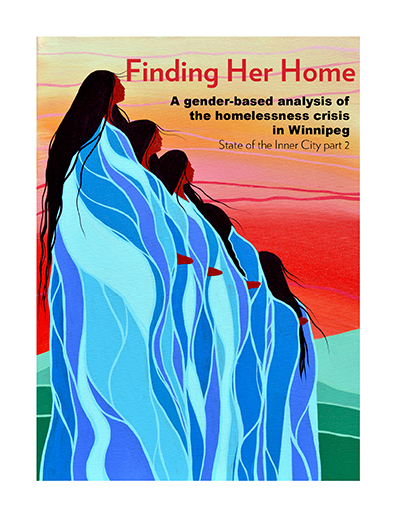 Artwork by Jackie Traverse
By Jenna Drabble
This winter, a 53 year-old woman died overnight in minus 32-degree temperatures, frozen to death on the streets of downtown Winnipeg. This tragic and preventable loss serves as a reminder of how Winnipeg is failing to support people who need it the most and that the homelessness crisis affects women. A new study released today renews calls to action to deal with this tremendously unjust situation.
In 2016, community-based organizations asked the Canadian Centre for Policy Alternatives Manitoba office to coordinate a study on women’s experiences of homelessness. It was noted that the province was celebrating 100 years since some women had received the right to vote; however, many women continue to experience marginalization, particularly when it comes to housing and homelessness. The results of this study, Finding Her Home, renew the call for more public investment and coordination across government and community to end homelessness.
 By Pete Hudson
In January, the government released the Toews report The Future of Home Care Services in Manitoba. The report was commissioned by the NDP government in 2015 as a follow up to an earlier report on Home Care (HC) from the province’s Auditor General. The two most compelling challenges identified in both reports are an anticipated rise in costs resulting mainly from an ageing population, and difficulty in recruiting and retaining staff. However, neither report paints a picture of crisis.

By Ellen Smirl
On the Main Street in Morden Manitoba there are two gas stations: an Esso and a Co-op. During the busiest times of the week-after a hockey game, or on Sunday when the area’s many churches let out-you will see cars waiting in line at the Co-op while the Esso remains virtually empty. Research shows that there are more co-ops and credit unions in rural communities compared to urban areas. These areas are also more likely to vote conservative. In the last provincial election, with the exception of three northern ridings, rural communities solidly elected blue candidates.
By Lynne Fernandez and Simon Enoch
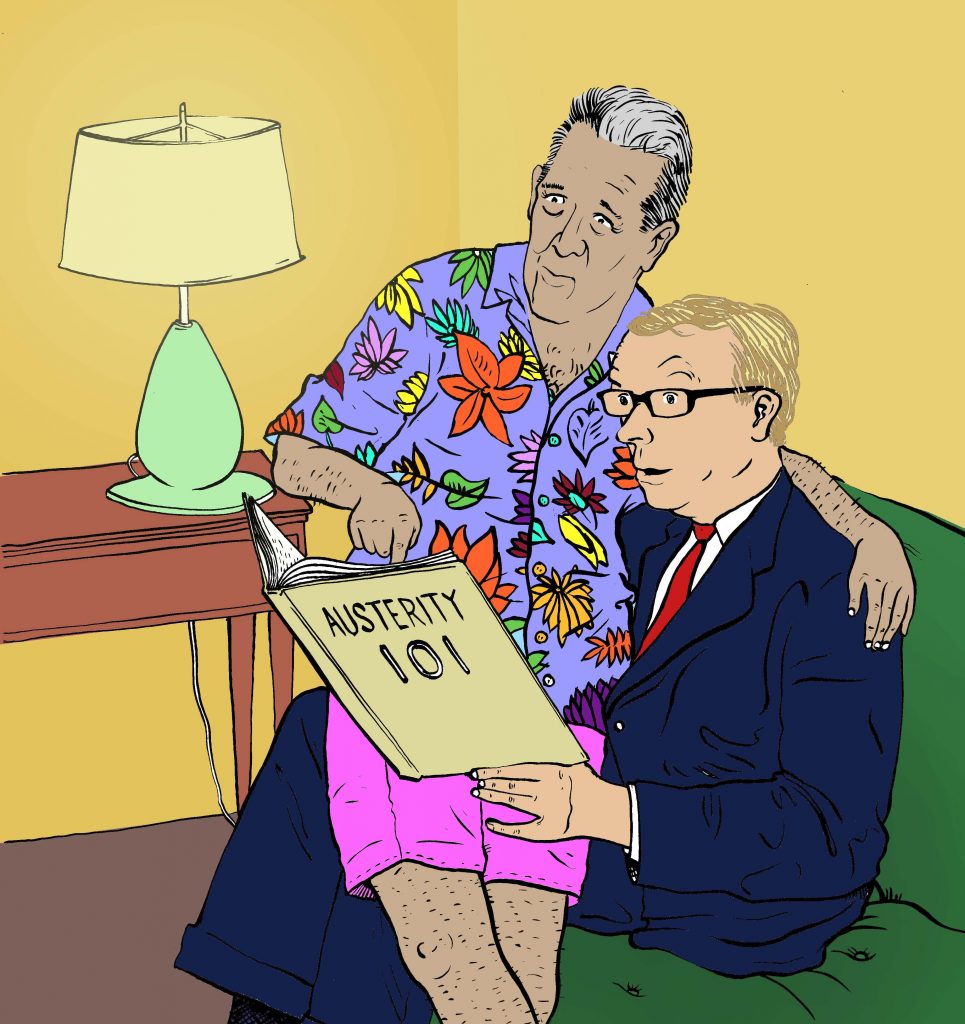
In the Fall 2016 Monitor, Canadian Centre for Policy Alternatives (CCPA)Saskatchewan’s Simon Enoch penned Getting to Know Brad, introducing Canada’s most popular premier – Brad Wall – to the country. He ran down Wall’s list of “accomplishments”. What made Simon’s analysis so interesting (and at the same time, disheartening) was how Wall has rolled out such a regressive agenda while remaining so popular. He noted that the rest of Canada needed to pay attention to Wall as he was beta-testing a number of conservative policy experiments that we could see replicated elsewhere.
https://www.youtube.com/watch?v=hs1WumFoxDk
Note time change! Feb 9th start 6:00 pm – come for 5:30 and buy your snack and beverage of choice.
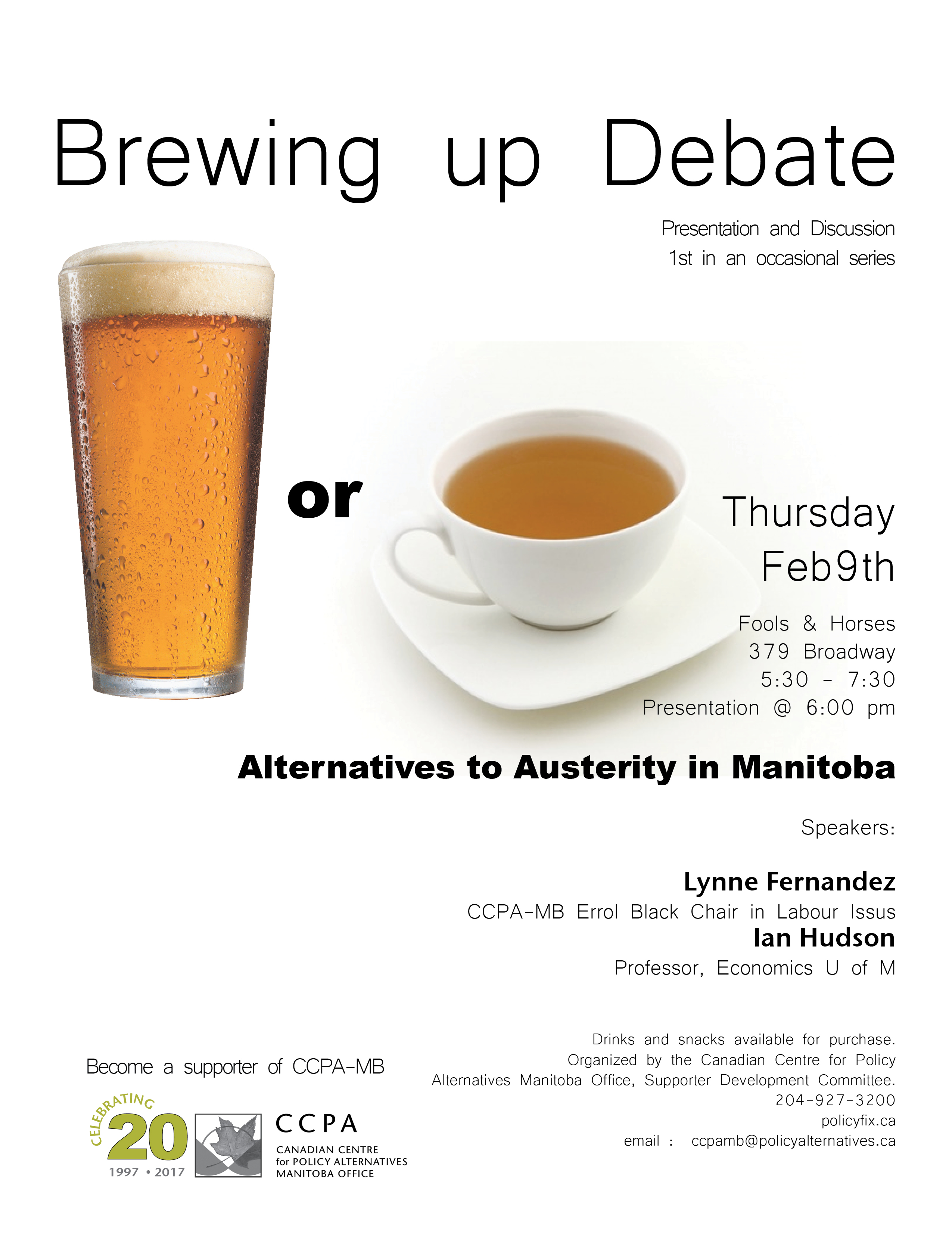 For video of this event click HERE.

By Sadie McInnes
The word trans is used to describe, “Someone who presents, lives and/or identifies as a gender other than the one they were assigned at birth” (O’Doherty 2016: n.p.). It is also an umbrella term for those who are not cis (a prefix or adjective that means “not trans,” derived from the Latin word meaning “on the same side”).
Trans includes people who are “transgender, trans(s)exual, non-binary, genderqueer, agender, bigender, genderfluid, intersex, and sometimes those who crossdress” (Ibid.). The experience of being trans is different for everyone; as O’Doherty (2016: n.p.) writes, “some people will want to undergo surgeries and changes to their appearance, others will not. It is important to respect and support the terms people use to describe themselves and the decisions they make for their own bodies.”
Supporting Refugee Housing and Resettlement Beyond the Syrian Refugee Crisis
By Ray Silvius, Hani Ataa Al-Ubeady, Dyland Chyz-Lund, Carlos Colorado and Emily Halldorson
In this report we demonstrate the specific constellation of events, initiatives, and supports that contributed to housing refugees from Syria who arrived in Manitoba beginning in November 2015. Relative to those of other recent refugee arrivals to Canada, the ‘Syrian Case’ has been unique, insofar as a considerable amount of national attention was devoted to the matter. The arrival of Syrians has been politically polarizing–indeed it became a decisive issue during the 2015 federal election in Canada and served as a touchstone for arguments for and against immigration to Canada, in general, as well as as supportive and reactionary sentiments about the presence of Muslims in Canadian Society. Read more…..
By James Magnus-Johnston
The federal government has stated that if provinces don’t impose a price on carbon, it will impose its own price by 2018. Trudeau has stated that “if neither price nor cap and trade is in place by 2018, the government of Canada will implement a price in that jurisdiction.”
Eight out of ten provinces will be designing their own mechanism to collect and “recycle” revenues under the new “Pan Canadian Framework on Clean Growth and Climate Change.” While Saskatchewan and Manitoba have chosen not to sign for now, Manitoba Premier Brian Pallister has stated support for a carbon price. He is currently withholding adoption until an agreement is reached over long-term health care funding.


Follow us!